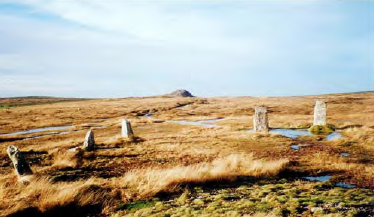
This Bronze Age ruined site, much disturbed by mine workings nearby, now has only 11 stones standing or leaning out of a probable original 19. Two stones were recently (2005) re-erected, and now the two portal stones frame the view to the rocky outcrop of Carn Gulva on the horizon. There may originally have been a processional way from the circle to this ‘holy hilltop’, perhaps thought of the dwelling place of the spirits of the ancestors, or the Gods/Goddesses.
There was also formerly a standing stone as outlier to the circle, 43 paces to the NW, which marked the direction of the midsummer sun set: now only a stump remains. A dug-out barrow encroaches on to the southern side of the circle, containing the remains of a central cist in which an urn and sherds of pottery were found. The remains of three more barrows lie to the north of the circle, one of which stands prominently on the summiit of a ridge, beside the path that leads to the stone circle from the Mên-an-Tol and Mên Scryfa.
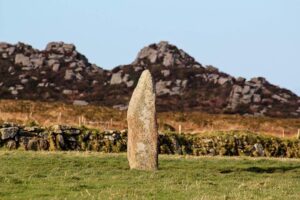
Mên Scryfa Standing Stone
This 1.8m (6ft) tall standing stone probably dates originally from the Bronze Age, but was re-used in the late Iron Age/Celtic period (5th or 6th